Miscellaneous Modifiers
Rabicano, Sooty, Pangare, Brindle, Manchado, Birdcatcher Spots, Chubari Spots, Bend Or Spots, Bloody Shoulder Markings, Gulastra Plume, Badger Faces, and other oddities
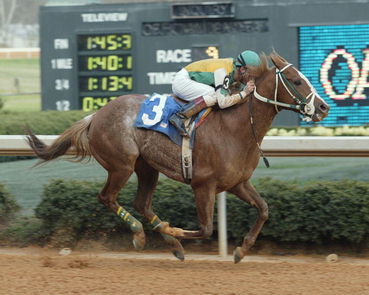
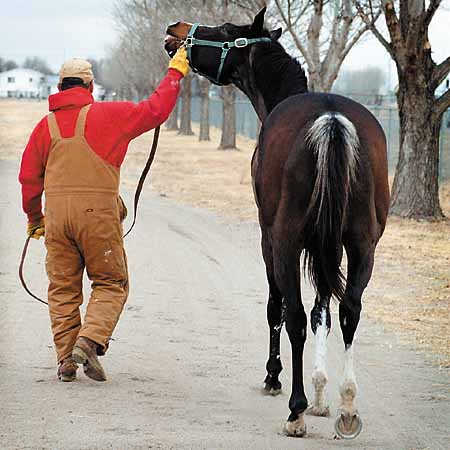
| Rabicano: Rabicano is a pattern that is often confused with true dark-headed roan. It is usually manifested as a sprinkling of white hairs radiating out from a horse's flank, sometimes spreading across the barrel and onto the shoulder. Rabicanos also often have a white-topped tail, known as a coon tail or skunk tail. There is some thought that rabicano may be tied to or somehow related to sabino as the rabicano pattern is often found in conjunction with sabino. Rabicano can act an any coat color. |
|
|
|
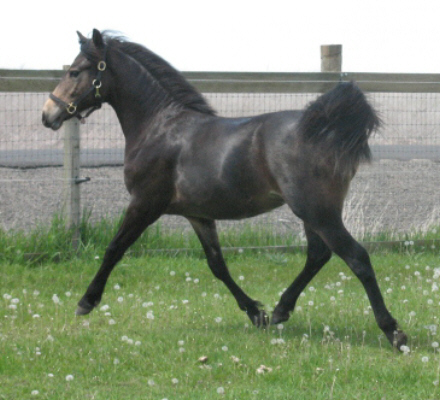
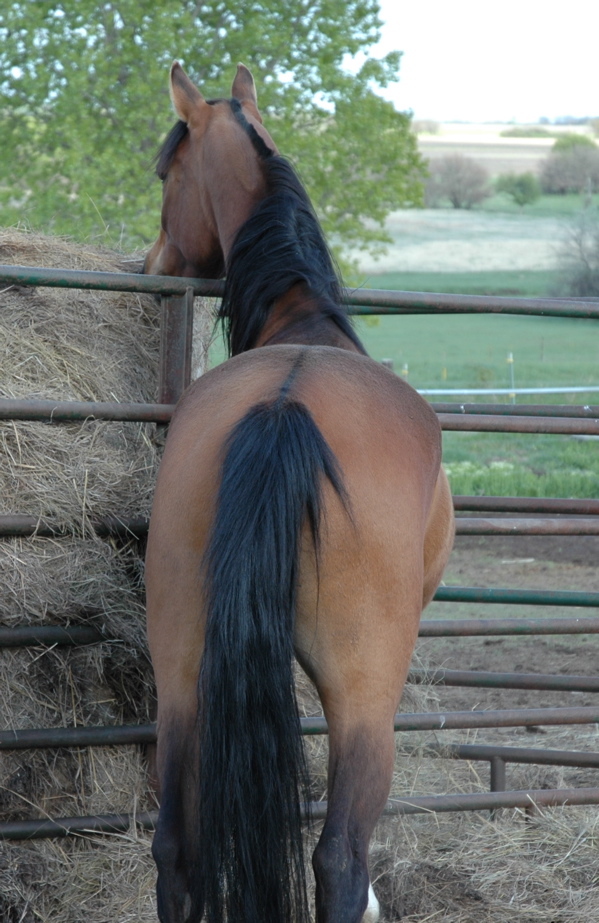
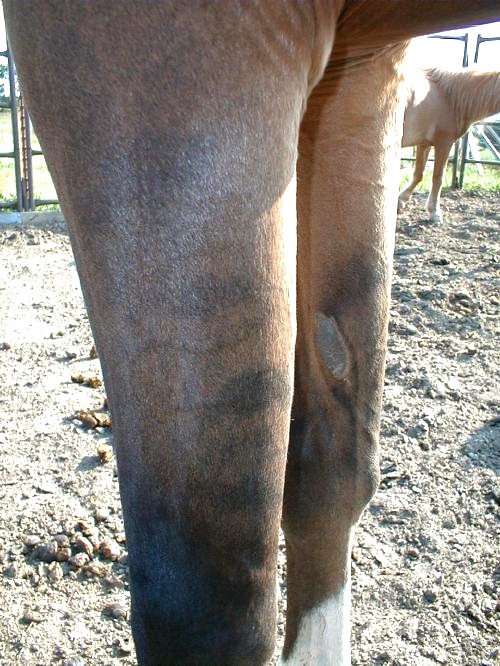
| Sooty: Sooty is a common color modifier that can act on both red and black based coats. Sooty, also known as smutty or countershading, causes dark hairs to be spread throughout a horses coat, usually concentrated from the top of the back down. Sooty horses often have spectacular dappling because of the contrast of colors in their coats. Sometimes the sooty hairs are concentrated into lines resembling leg barring and dorsal stripes on non-dun horses. Some horses are so sooty that their true color is nearly unrecognizable. For example, some sooty buckskins have been mistaken for dark bay or black horses, such as the pony pictured below on the right. |
|
|
|
|
|
|
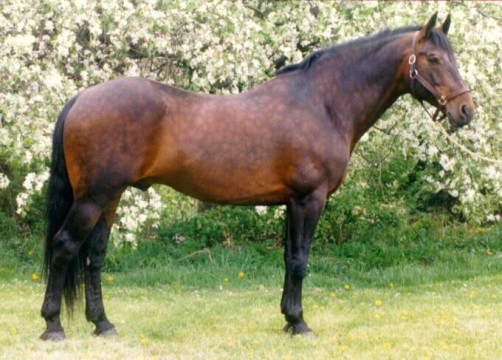
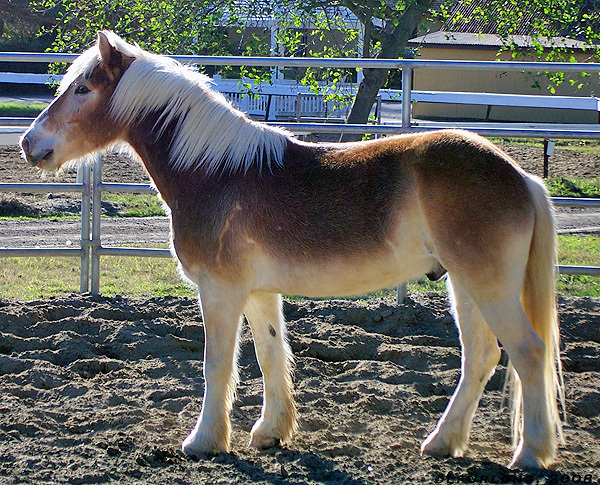
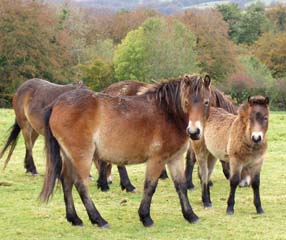
| Pangare: Pangare is a modifier that acts by lightening certain portions of a horse's coat, usually the muzzle, the belly, the inner forearms and thighs, and sometimes even the chest or around the eyes. When it acts on a chestnut coat, the horse usually will have a flaxen mane and tail. It can act on a variety of coat colors and varies in intensity. It is often found in pony and draft breeds, such as Haflingers, Fjords, Exmoors, |
|
|
|
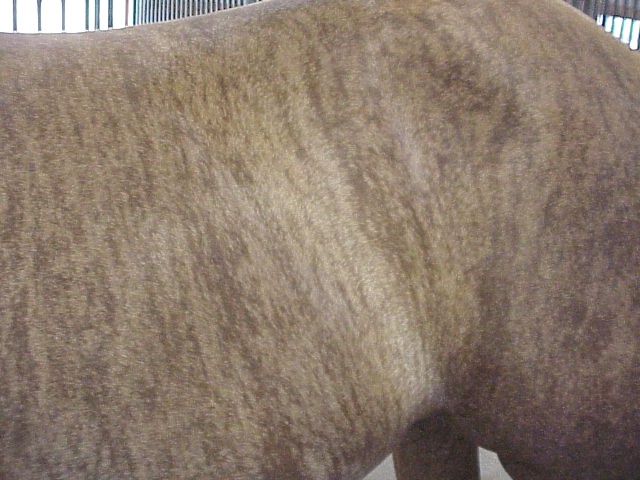
| Brindle: Brindle is an unusual pattern of dark, vertical lines on a lighter-colored coat. Though it is seen in a variety of breeds, it is quite rare. The genetics of brindle are unknown, but according to Dr. Philip Sponenberg, the man who literally wrote the book on equine color genetics, "brindle seems to require sooty black countershading for its expression, and reorganizes sootiness into vertical stripes instead of a more uniform sprinkling of hairs." I have included a few pictures of brindle horses below, but for more information on the history of brindle horse and more photos, please check out Sharon Batteate's excellent site: http://members.aol.com/brindlehos |
|
|
|
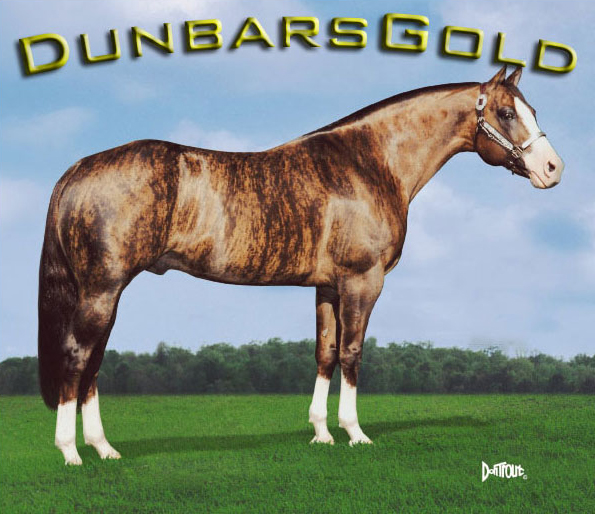 |
The brindle coat pattern is occasionally caused by a rare genetic occurrence called chimerism. Dunbar's Gold, pictured at left, is an example of this odd phenomenon. In a nutshell, a chimeric horse develops when two fraternal (non-identical) twins fuse into one embryo in utero. Dunbar's Gold, therefore, has two sets of DNA, resulting in his brindled coat. For more information about his fascinating story, check out this article published in the February 2006 American Quarter Horse Journal: http://www.aqha.com/magazines/aqhj/content/06february/oneinamillion.pdf (Photo by Dan Trout) |
|
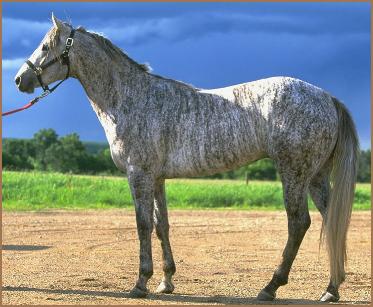
Reverse or White Brindle: Most brindle horses have dark stripes on a lighter body color, but a rare few have white stripes on a dark body color. While it is possible that white brindles are chimeric (and certainly some may be), the current thought is that the color is either the result of a one-time mutation or may be the result of pigment cells not migrating from the topline during development in utero (a somatic mutation). Simply put, that means that the white brindled color is unlikely to be passed on to a horse's offspring, but in at least one case, the mutation has resulted in unique offspring. The well-known Thoroughbred stallion Catch A Bird (pictured below left) sired four phenotypically roan foals. That is significant because true roan was not present in the TB population until that point. To the best of my knowledge, CAB's foals have never been genetically tested, but his roan daughter Slip Catch has produced two roan daughters herself. (More about this remarkable family on my TB color page.) Given that most horse colors are thousands of years old, new mutations like this are exceedingly rare. Pictured at right is Natal Classi, a Brazilian Warmblood imported to the USA. He was at stud Stoneybrooke Farm in KY as of 2009. I gather he has sired some foals, but as of November 2011, I'm not aware of any brindled or roan offspring. |
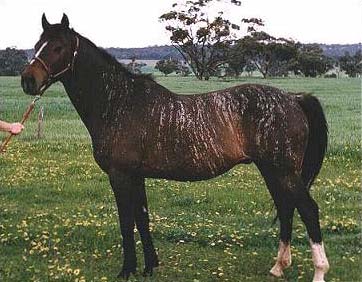 The late, great Catch A Bird |
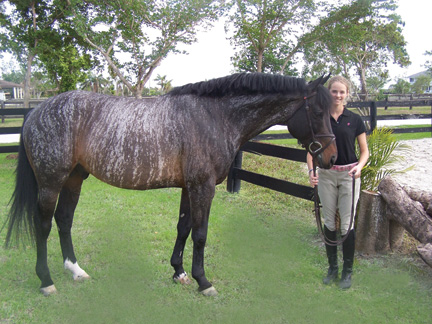 Natal Classi, a Brazilian Warmblood. |
|
Manchado: Manchado is a rare pinto pattern that has only cropped up in Argentina in a handful of horses from various breeds (Criollo, Hackney, Arab, TB, etc). It is thought to be the result of a very rare recessive gene, but it has not yet been mapped. (The pattern is not known to be related to other spotting patterns like the leopard complex.) It may also be the result of a random mutation like white spotting. |
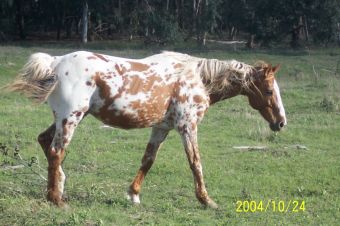 This is Royal Manchado, a Thoroughbred stallion. |
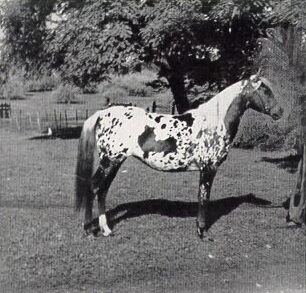 This is Trabag, a champion Arabian mare. |
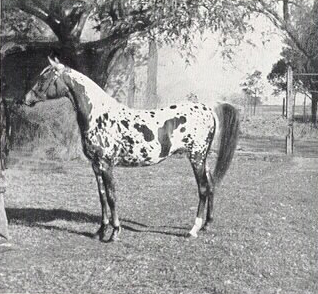 Trabag's other side. None of her foals inherited her strange coat. |
|
Seeing Spots: A variety of non-Appaloosa spots do occur in many breeds: Birdcatcher spots, named for the Thoroughbred stallion who exhibited them, are small, round, white spots scattered throughout a horse's coat. In many cases, the spots appear and grow in number for a period of years, and then gradually fade away. Sometimes, the spots will persist throughout a horse's lifetime. Chubari spots are similar, but are usually larger, often egg-shaped and egg-sized. They seem to occur exclusively on grey coats, and of course, fade as the grey coat fades. Most grey TBs and grey horses with TB breeding can trace their spots back to The Tetrarch, a brilliant racehorse in England in the early 20th century. He sported a number of these large spots, earning the nickname the Spotted Wonder, and they are sometimes referred to as Tetrarch spots for this reason. Bend Or spots are also named for the TB stallion who bore them. They are random dark spots on a lighter coat, often seen on chestnuts and palominos. They vary in size, sometimes only dime-sized, and sometimes as big as an outspread hand. |
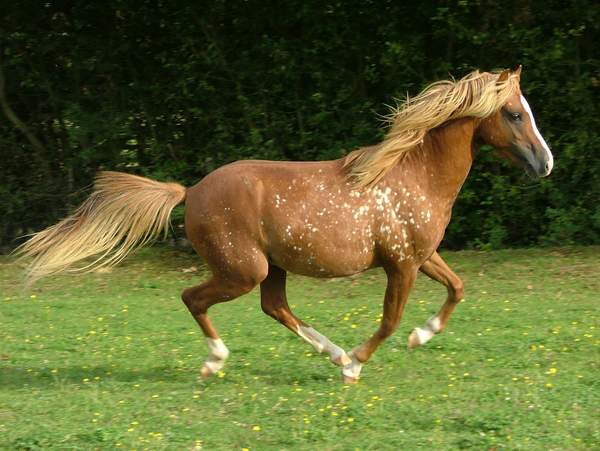 Birdcatcher spots on an Arabian. |
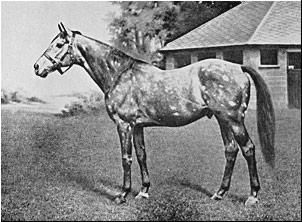 The Tetrarch sporting his large chubari spots. He was nicknamed the Spotted Wonder. Many grey TBs have at least a few of these spots. |
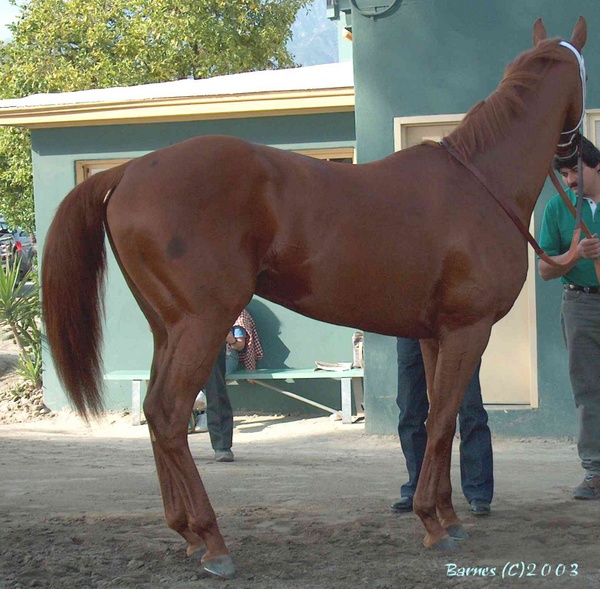 The Thoroughbred stallion Big Country exhibiting Bend Or spots. (Photo by Laura Barnes) |
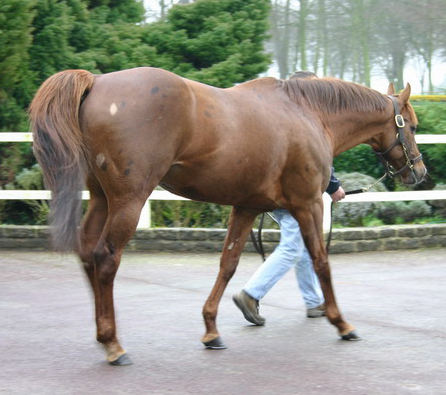 This is Green Tune, another TB, who has a multitude of Bend Or spots as well as some odd light spots. The champion TB mare Azeri also has an white spot on her rump much like Green Tune. (Photo by Sabrina D.) |
| Bloody Shoulder Markings: Bloody shoulder markings are random patches of color on grey horses that simply do not grey out. Despite the name, they can be found anywhere on a horse's body. |
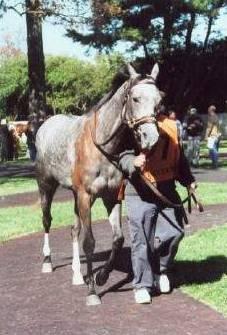 This is Charmander, a bay-based grey Thoroughbred filly. She is pictured here at about 3 years of age. |
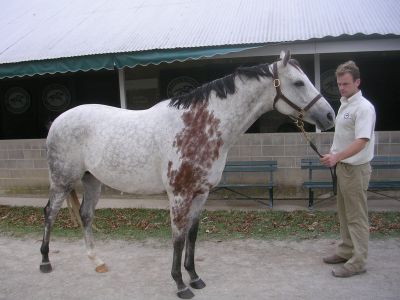 Here is Charmander again a few years later. |
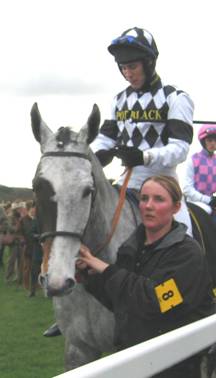 This is Laska de Thaix, a grey with a bloody shoulder mark on his head. |
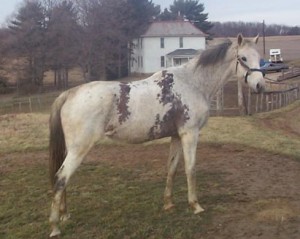 This is Brilliant Bird, a Thoroughbred with markings on his shoulder, barrel, and flank. |
| Gulastra Plume: A gulastra plume, named thus by Arabian breeders, is an interesting manifestation of sabino that creates a light colored tail on an otherwise solid-colored horse. It is not to be confused with rabicano. |
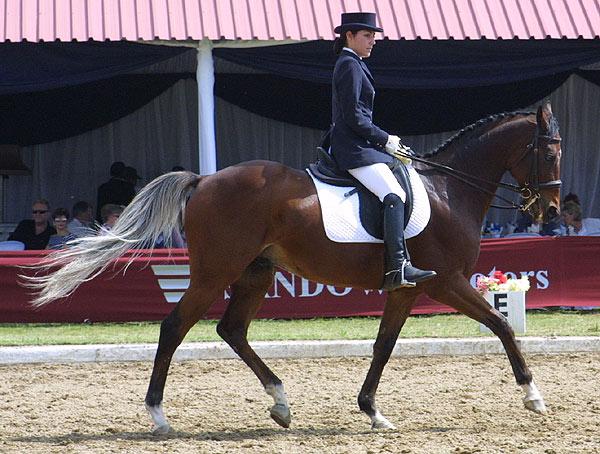 Donatello, a handsome Thoroughbred. |
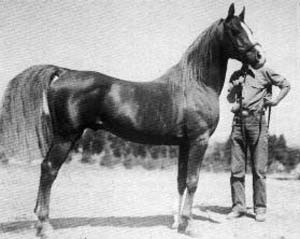 The eponymous Arab, Gulastra. |
| Badger Face: A badger face marking is usually the result of a skewed pattern or an occluded blaze. It resembles a reverse blaze. |
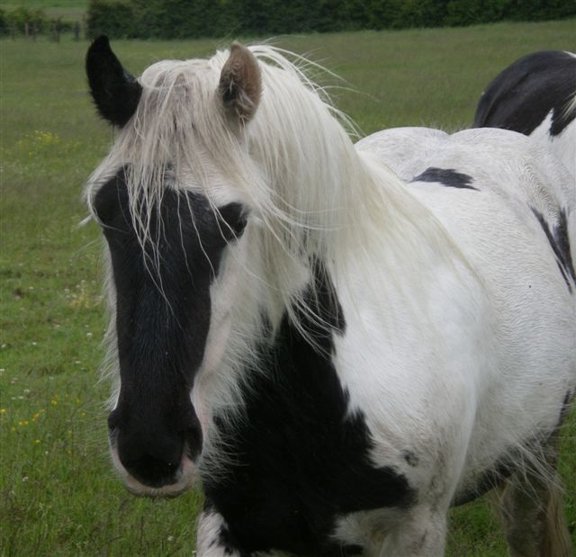 A lovely badger-faced tovero (probably tobiano + sabino) Gypsy Vanner. (Owned by ?) |
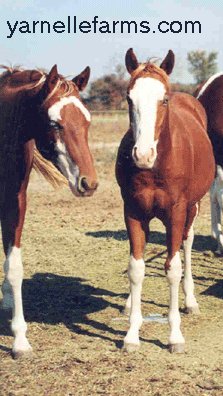
| Chimeras: As discussed above (in the brindles section), chimeras are the result of the fusing of fraternal twins in utero resulting in 2 sets of DNA in 1 horse. The dual DNA is not always manifested as brindle. Often. it results in random patches of color like the horses below. |
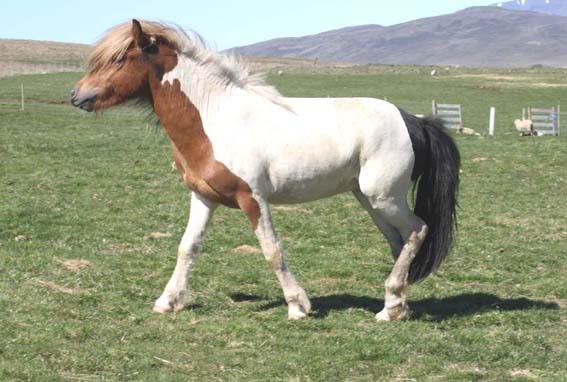 Litningur frá Mörðufelli , a chimeric Icelandic Pony owned by Matthías Eiðsson. |
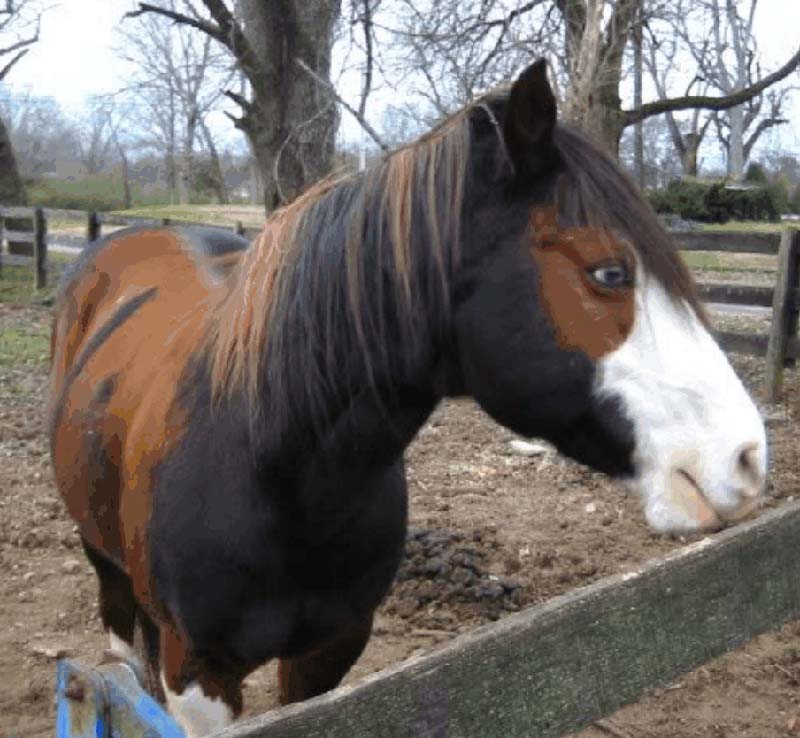 Stetson's Mr. Blue, a chimeric Paint horse |
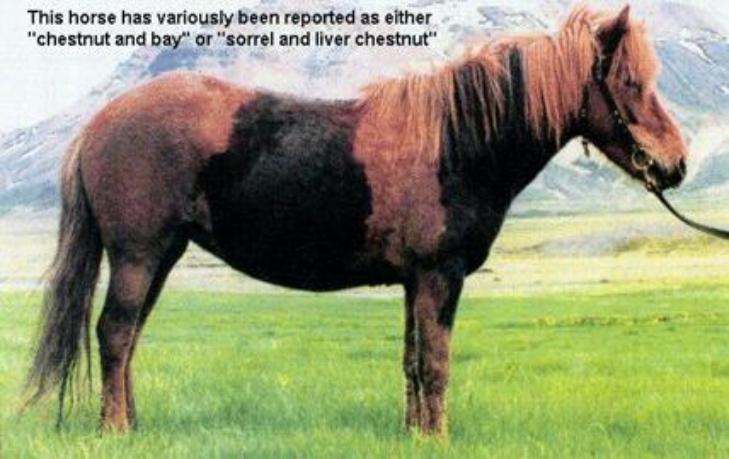 Miljon fra Grund, another chimeric Icelandic Pony |
|
| Somatic Mutations: Somatic mutations are the result of a gene that is accidentally switched "off," often resulting in odd patches of color on an otherwise ordinary coat. |
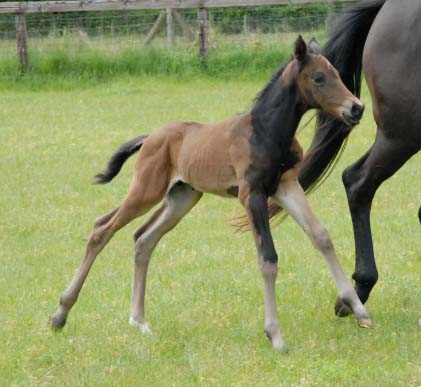 This Trakehner colt, Holme Park Van Gogh, was an excellent example of a somatic mutation. The black patch on his otherwise bay coat was the result of the agouti gene misfiring leaving that section of his coat an undiluted black. |
|
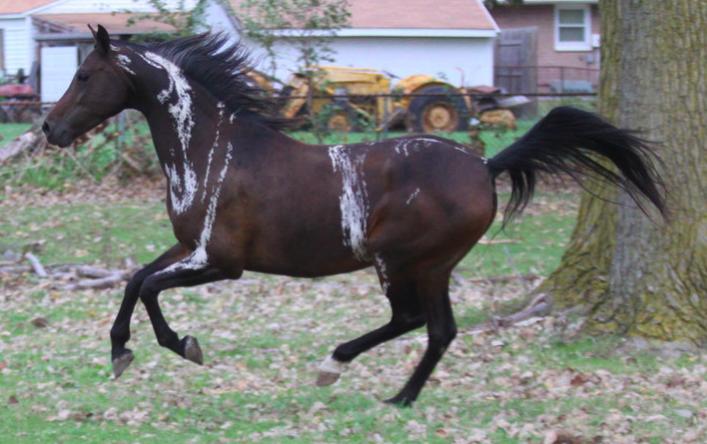
| Environmental Factors: Occasionally things like viruses and fungal infections can affect the appearance of a horse's coat. While they look odd, these markings are not the result of genetics and are not hereditable. Scars (from poor-fitting tack, etc) have a tendency to grow in with white hair as well and are likewise not hereditable. |
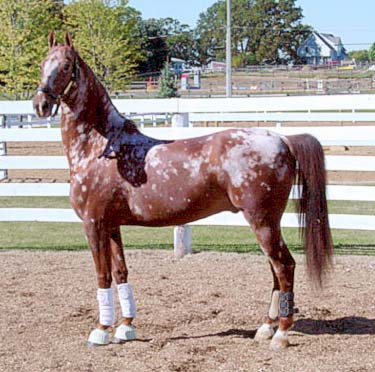 And here he is afterwards. Despite aggressive treatment, his coat was scarred by the infection. Initially his spots were very white, but they faded with time, and eventually, his chestnut coat grew back in. |
|
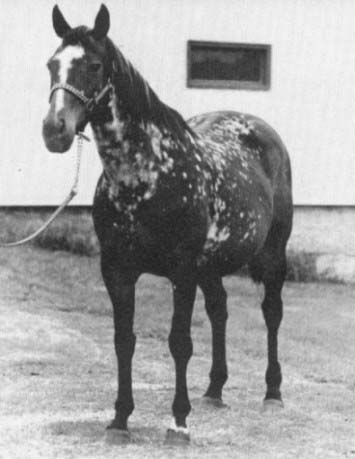 This is Pelouse's Queen, a TB mare whose odd pattern is in keeping with the damage done by a fungal infection. She was purchased by an Appaloosa breeder, but as she did not of course carry the leopard complex (not found in TBs), she could not pass on the color. |
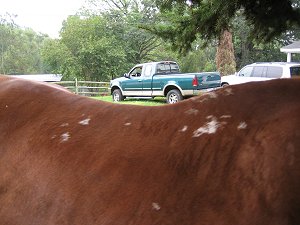 An example of saddle sore scars where the hair has grown in white. Not to be confused with appaloosa spotting, Birdcatcher spots, etc. |
| I'll add more oddball colors and patterns as I find the time---mushroom, macchiato, etc. |