White Spotting
| Thoroughbreds are know to have a number of white spotting
patterns (formerly called dominant white or extreme sabino) with
a range of expressions. At one time, these patterns were thought to be
the result of sabino, but interestingly, no white patterned Thoroughbreds
have been found to carry Sabino-1. White spotting (W) is family of spontaneous
mutations of the KIT gene--- this is why white horses crop up from seemingly
ordinary, solid-colored parents. Twenty W-mutations have been identified
to date (2015), six of which originate in Thoroughbreds, and one more
seems to be wide-spread, including in Thoroughbreds. They are: W2: KY Colonel line which gave rise to the well-known Patchen Beauty family W5: Puchilingui line W6: Unidentified white TB born in 2004 (possibly Marumatsu
Live) W12: Unidentified white TB W20: May be responsible for what we think of as "normal" markings (socks, blazes, etc). Has been found in conjunction with other W-mutations, and seems to act as a white-booster. White spotting patterns vary in expression. Puchilingui's family tends to produce horses that are a mix of their base color and white. Horses from the Patchen Beauty and Shirayukihime lines tend to produce horses that appear all white. (Most do still have some spots of dark color in their ears or along their top line.) |
|
|
|
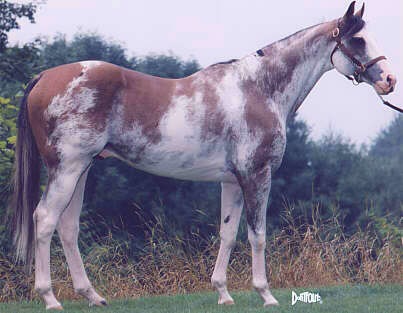
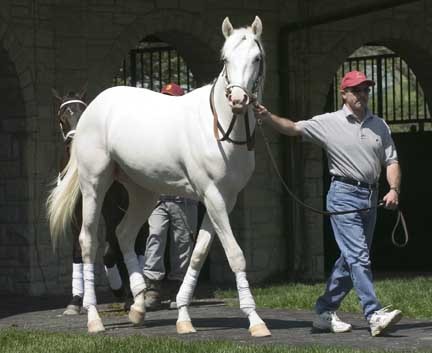
Click here for more information on the myths and facts about "white" horses. More pictures of pinto TBs can be found here.
| There are a variety of Thoroughbreds who fit the white spotting template but whose W-mutations have not yet been identified. These include Not Quite White (dam of Airdrie Apache), Our White Lady, The Opera House, etc. As with the identified W-mutations, a range of expression is found in the unidentified but presumed W-families as well. Airdrie Apache's family in particular tends to produce partially white and all white horses, suggesting that it may be a W-pattern that is boosted when combined with another W-mutation. |
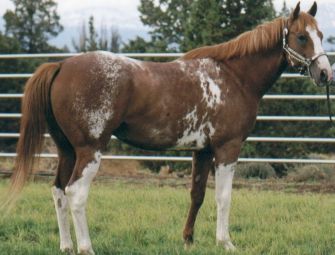 Airdrie Apache is a son of the nearly all white mare Not Quite White. The W-mutation for this family has not yet been identified. He was bred and owned by Painted Desert Farm. |
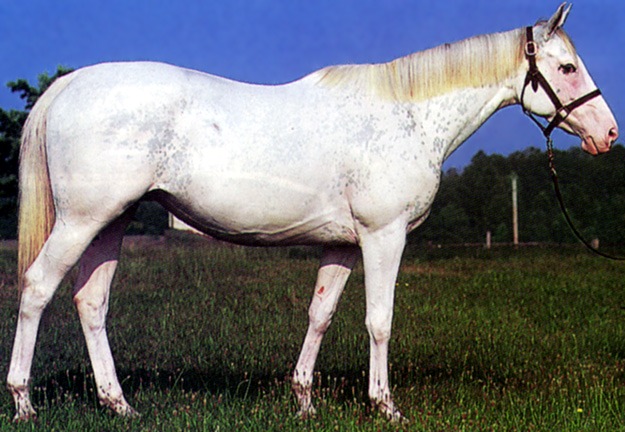 Arctic White, a son of Airdrie Apache. |
| Thoroughbreds with loud markings like wide blazes and tall socks have been found in the breed since its inception. The Darley Arabian, perhaps the most influential of the Arabian foundation stallions, was himself a boldly marked bay. Northern Dancer is an example of a well-known modern source of bold markings in Thoroughbreds. For a long time, these markings were thought to be the result of sabino, but recent genetic testing has forced us to rethink that. |
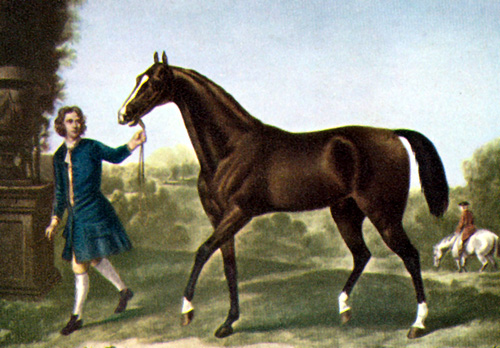 The Darley Arabian, one of the founding sires of the Thoroughbred. |
|
|
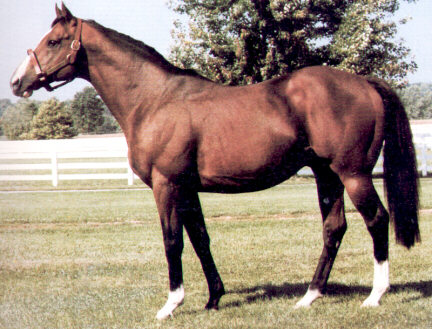
 The
lovely stallion Marquetry who had fascinating markings. (Photo
by Tony Leonard)
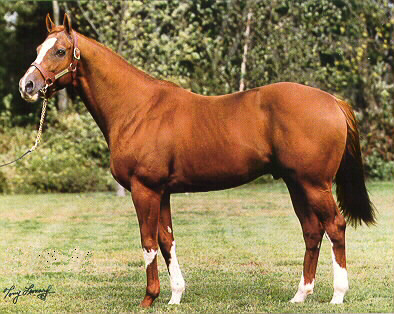
The
lovely stallion Marquetry who had fascinating markings. (Photo
by Tony Leonard) Frame Overo
|
The frame overo pattern does exist in the Thoroughbred gene pool, but it is limited to only a handful of family lines. The only frame overo TBs I know of have cropped up in the last 20 years. All are from relatively obscure lines, and the presence of the pattern may be due to a random mutation. In TBs, frame is almost always seen in conjunction with the sabino pattern which makes for some spectacularly patterned horses. Horses carrying only the overo gene often have four dark legs. White legs on a horse also carrying frame overo usually indicates sabino or another white pattern at work. |
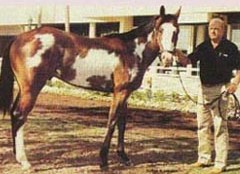 |
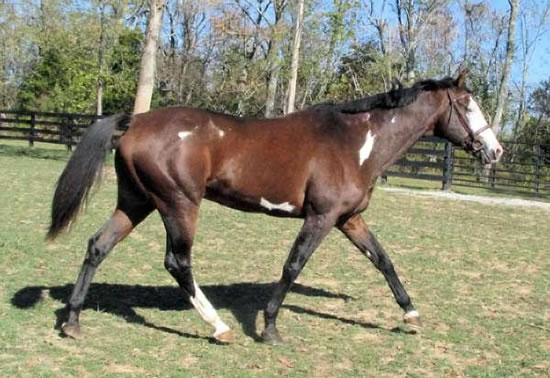
The first frame TB I'm aware of is Tri Chrome (shown with trainer Jack Van Berg), a bay overo horse by Blue Gazi born in 1991. Sadly, he was euthanized at a young age after being kicked in the paddock before a race. He was never bred. |
 |
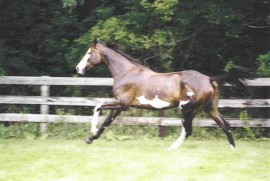
This is Blue-Eyed Streaker, a 1993 bay overo stallion, also
a son of Blue Gazi. He currently stands at Echo
Hill Farm. If anyone has a picture of Blue Gazi, I would very much like to see it. Thanks! |
 |
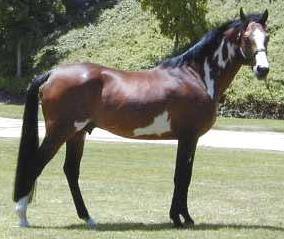
And this is alleged to be Fillipas Puzzle (Great Deal x Phillipes Doll, by My Phillipe), a 1993 bay overo mare who is truly a puzzle. Her whereabouts are unknown, and she has no known progeny. Any further information on her would be greatly appreciated. |
 |
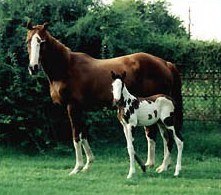
The most prolific family of frame overo TBs stems from the pairing of two "half" siblings, Pesty Axe and Torchy's Rainbow, both by Give Em The Axe. They produced two foals, Nite Spot in 1985 and Patchy Lassy in 1989. Nite Spot is a boldly marked bay frame overo, and his sister is a chestnut with a big blaze and tall stockings. Nite Spot stands in Germany at Gestüt Falkenhorst. (Photo by Rebecca Hatchell.) |
 |
Patchy Lassy, shown here with her 2000 colt Ellusive Quest, is a minimaly expressed overo (presumably). Quest's frame pattern is probably boosted by some version of white spotting. (Both horses are owned and photographed by Nancy McEachern of Color World Ranch.) |
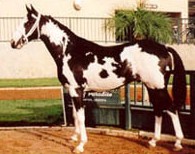 |
The late, great Racey Remarque, a 1997 black frame overo son of Patchy Lassy. Thankfully, he sired some lovely overo foals before his untimely death. (Owned and photographed by Nancy McEachern of Color World Ranch.) |
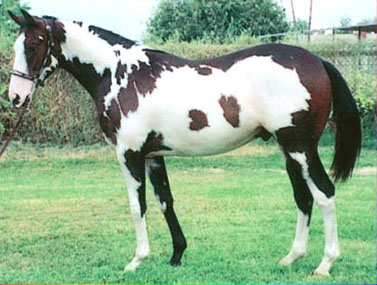 |
Is this guy something or what? He is the very handsome Ellusive Quest (as pictured above with Patchy Lassy), a full brother to Racey Remarque. He had a brief racing career, but was retired to stud when his brother died. (Owned and photographed by Nancy McEachern of Color World Ranch.) |
Splash White
| The splash white overo pattern has only recently been recognized in the Thoroughbred. Though there have been a few isolated reports of potential splash whites, no good examples were found until a mare named Hey What The in New Zealand produced two unique fillies in 2003 and 2004. As with the frame pattern, the origins of splash in TBs are mysterious. In heterozygous form, splash can be very minimal, as little as a small snip on the nose, so it may have flown under the radar, so to speak, or it my be the result of a spontaneous mutation. |
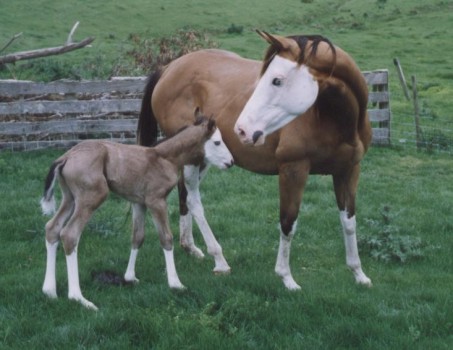 |
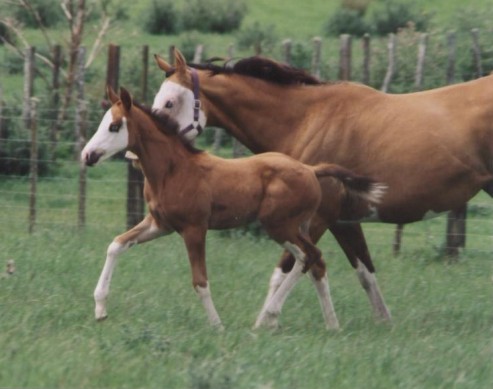
This is Hey What The, a bay splash 1998 mare by Hey Baba Riba (NZ) out of Nagol Lass (NZ), by Americus (IRE), pictured with her 2004 filly Bubba by Go Corp (NZ). Hey What The is currently owned by Massey Farms; Bubba unfortunately was euthanized in 2008. |
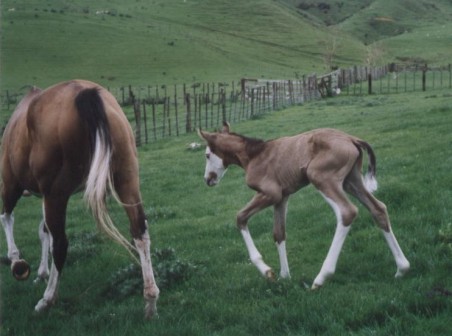 |
Here are Hey What The and Bubba again showing off their white tail tips, classic indicators of splash. And though you can't see it in these photos, HWT has a big white belly spot as well. |
 |
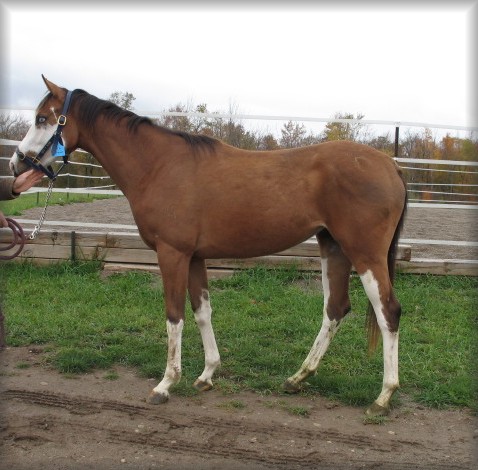
This is Hey What The with her 2003 filly Whatever also by Go Corp (NZ). Whatever is currently owned by Painted Fox Horses. |
 |
A photo of Whatever on the day she arrived in the USA. |
Seeing Spots: Birdcatcher Spots, Chubari Spots (aka Tetrarch Spots), Bend Or Spots, and Manchado
| These odd patterns of dark and light spots do occur in other breeds, but they seem to be particularly prolific in the Throughbred, and many of them are actually named after TBs. The genes responsible for these spots have not yet been identified, so not a great deal is known about them. |
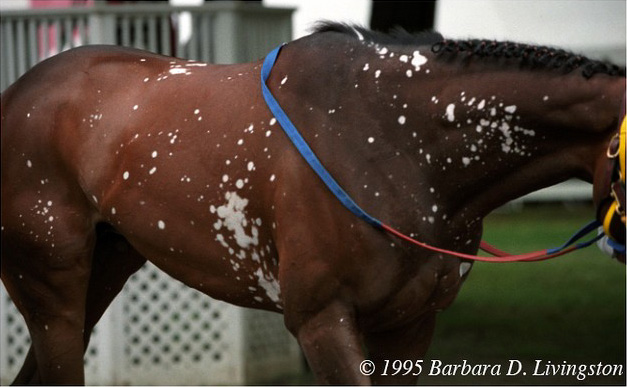 |
Birdcatcher spots or ticks are patterns of small white spots on a dark coat. Usually, these spots appear once a horse has reached maturity and eventually disappear. Sometimes, however, they do seem to be permanent. This is Willspynow, a 1991 mare by Well Selected out of Spy Gail, by Father Hogan. This mare's spots are bigger and more highly concentrated than most Birdcatcher spots. (Photo by Barbara Livingston) |
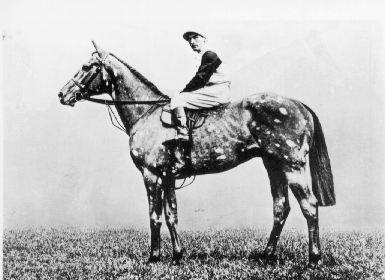 |
Chubari spots (also sometimes called Tetrarch spots) are similar to Birdcatcher spots except that they tend to be much larger. They are usually egg-shaped and egg-sized, as seen here on The Tetrarch. They seem to be tied to the grey color, but they are different from dapples. Dapples can change and fade as the horse ages, but chubari spots don't disappear until the horse has completely greyed out. Many grey TBs have a few chubari spots but it is unsual to see a horse with as many as The Tetrarch. |
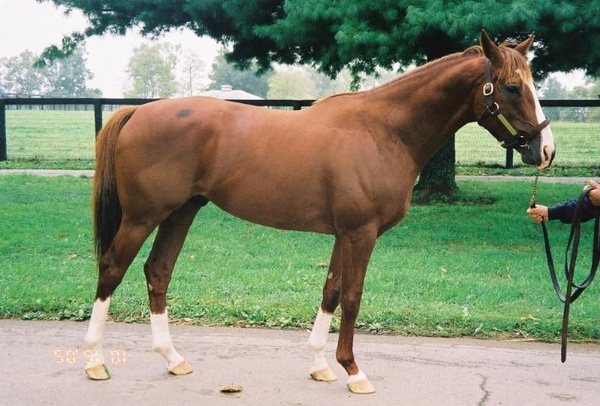 |
Bend Or spots are random dark spots on a horse's coat. Man O' War, a descendant of Bend Or, is said to have had these spots. Pictured at left is Commendable, the 2000 Belmont winner, who has a Bend Or spot on his right hip. Bend Or spots seem to show up most frequently on chestnuts and chestnut-based colors, like palomino, but they can occur on other colors. (Photo by ?) |
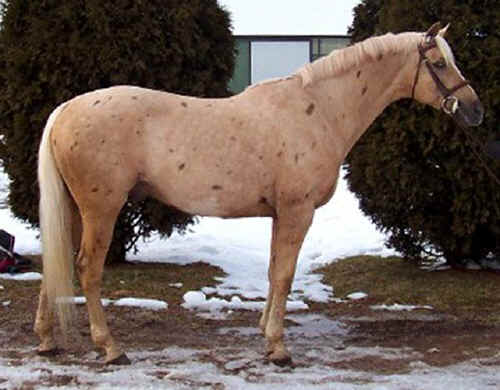 |
This is GP's Krugerrand, a palomino TB who is covered in Bend Or spots. |
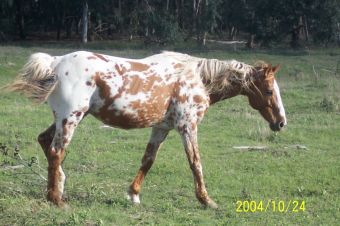 |
This pattern is known as manchado or "manchado overo." It has only cropped up in Argentina in a handful of horses from various breeds (Criollo, Hackney, Arab, and TB so far). Little is known about manchado at the moment, but it may be an exceedingly rare recessive gene. The pattern is not known to be related to other spotting patterns like the appaloosa pattern or Bend Or spots. The horse pictured is a Thoroughbred, Royal Manchado, a 1990 stallion by Royal Castle (ARG) out of Kleymary (ARG), by Manchester (ARG). (As a sidenote, here is a photo of the manchado purebred Arab mare Trabag born in 1946. She did not pass her pattern on to any of her foals.) |
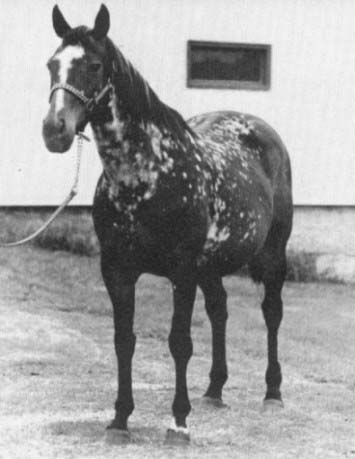 |
Some spots are the result of environmental factors rather than genetic ones. Pelouse's Queen (Pelouse x Harem Queen, by Nathoo), a 1965 dark bay Thoroughbred mare, was so afflicted by a skin disease that her coat grew back in white where it had been scarred by the fungal infection. She was purchased by an Appaloosa breeder, but as she did not of course carry the leopard complex (not found in TBs), she could not pass on the color. |
